Saturday, 19 March 2011
The A-Z Of All Time Great Pop Singles: "C"

Monday, 7 March 2011
The A-Z Of All-Time Great Pop Singles: B
B is for: "Boom! Shake The Room" - Jazzy Jeff & The Fresh PrinceWhat, no Be My Baby? My choice for "B" presents the perfect
opportunity to confirm an essential aspect of this A-Z, which is that I intend to compile it instinctively, in a first-thought, best-thought sorta way - this is a list of pop songs that matter to me personally, which spring immediately to mind because they're heavily playlisted on mybrain FM, rather than an exercise in advertising what refined taste I have. So I coulda chosen the undeniably wondrous Phil Spector / Ronettes girl-group classic, and almost did...but the truth is what I always really wanted to pick was Boom! Shake The Room, by Jazzy Jeff & The Fresh Prince. So I have.
"The f-f-f-f fresh p-p-p-prince is who I am: so tell my mother that I never wrote a wack jam."
Should an alien race ever require the people of earth to provide a sample of our best work, we would bundle William Smith up onto a rocket ship and send him hurtling off into the cosmos, with a suitcase containing the Fresh Prince of Bel Air DVD box-set, Men In Black, 'Summertime', 'Miami' and this record on 12" vinyl, and a note stapled to his t-shirt saying "Now show us what you've got." Will Smith is about as bankable a celebrity as it's possible to imagine, and B!STR is a Very Commercial Record. It's essentially LL Cool J's Momma Said Knock You Out, already a relatively pop rap single, with every pop hook turned up to 11, an explosion for a chorus, and a lead vocal performance by the most charismatic man on the planet. If hip-hop heads wanna grumble about how "sanitised" Will & Jazz's version of Rap Music is here, let 'em. One of pop music's roles is as a gateway drug to harder, more adult kicks. B!STR was a sneaky toke behind the bikesheds for a generation of Fresh Prince teens, who the very next year were probably nodding out in their bedrooms to the sounds of Cypress Hill and Snoop Dogg.
Friday, 7 January 2011
The A-Z Of All-Time Great Pop Singles: "A"
A is for "ABC" - The Jackson 5As near as dammit, the perfect pop-song, and a most appropriate place to begin my 'ABC' of all-time great singles. The Jackson 5's ABC is 2:54 of pure, unbridled, unselfconscious fun -it is a song that exists to remind everybody what pop music is. Exuberance, vitality, sheer youthful joyfulness - ABC is conceptually patterned as a lesson in love, but the real lesson here is in pop-ology. It is the York Notes of sweet soul music. Musically, it's as arresting as anything Motown ever did. ABC has the good sense to kick off with a fat, buzzing fuzz-bass line, before dropping into a steady pimp rollin' funk groove 5 seconds in; the mix is packed with loadsa conga, tambourine and jangling piano, and at some point around the 1:40 mark the J5 strip it all back to a breakdown like a kindergarten Temptations. Vocally it's just on another level; every line is delivered like it's the hook, and wildly creative things are done with the phrasing and arrangement throughout. I wonder what ever happened to that kid with the high pitched voice?
Sunday, 2 January 2011
2010 Review: A Year In Stuff I Liked
Enter The Magical Mystery Chambers - Wu Tang Vs The Beatles / Tom Caruana
Conceptually a weaker effort than Dangermouse's Beatles breakbeat benchmark 'Grey Album', but for my (admittedly Wu Tang fanatical) dollar this mash-up is a far more entertaining listen front-to-back. The tracks that work far outweigh those that don't, and a handful (the bludgeoning, 'I Am The Walrus' sampling "Run", a re-make of "C.R.E.A.M." almost as smooth as the original, & the centre-piece, show-stopping "Uzi (Pinky Ring)") have remained heavy rotation heavyweights on my ipod all year. Precisely the sort of post-modern irreverence that Lennon woulda loved.
Book Of The Year
Dino: Living High in the Dirty Business of Dreams - Nick Tosches
Everything you need to know about mid-20th Century US pop culture is here. A serious - but never remotely dry - book, packed with punchy, profane prose, placing the vacant, solitary anti-hero figure of Dean Martin at the centre of a wide ranging cultural discourse on pop music, film, showbiz, television, sex, money etc etc...and however black the oblivion of Dino's empty megastardom gets, you still wind up with the impression of Martin as the Rat Pack's true hipster - a dispassionate, untouchable, grade-A bad-ass - "the cool guy's cool guy".
Film Of The Year
Toy Story 3 - Dir. Lee Unkrich
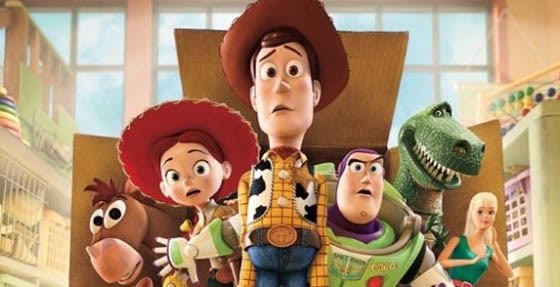
In which everybody is forced to recognise the shocking frailty of thier own mortality via a fiery pit-hell incinerator scene where Woody, Buzz and the Toy Story Gang take one another's hands and accept their own imminent and certain doom with quiet, heart-breaking dignity. Peerless popular art, bursting with imagination, and with an emotional depth of resonance greater than any number of the "serious" middle-brow movies with which Pixar will compete - I suspect fruitlessly, mores the pity - for a Best Picture Oscar come February.
TV Show Of The Year
The Office (An American Workplace) / Curb Your Enthusiasm
I'm gonna have to chicken outta making a definitive call on this one. Overall, these are very different shows; the former has a warm, beating heart the size of a watermelon and gets slushier by the episode, happily embracing it's position as the closest any post-Friends sit-com has come to reconciling the briefly un-cool merits of A Bunch Of Likeable People Who Actually Like Each Other mainstream comedy with the edgier, taboo-trampling brinksmanship of Gervais / Merchant's British original, while the latter is characterised by a no-holes-barred barrage of mind-boggling "WTF" moments that re-invents the Seinfeld formula of jaw-dropping social awkwardness + astonishingly tight narrative structures + self-reflexivity + people who hate themselves and everyone the know, on an operatic scale, making Gervais / Merchant's efforts seem conservatively quaint by comparison. I admire and enjoy them both equally. A dead-heat, then - The Office, for the sheer number of hours of pleasure it has given me this year, and CYE, for those spectacular, fan-pleasing Seinfeld reunion episodes.
Songs Of The Year
.1. In Tha Park - Ghostface Killah Crunching, distorted, heavily fuzzed, block-party rockin', psyche-soul, old-skool flavoured hip-hop ticks every one of my boxes. With deliberate nods to P Diddy's "Bad Boy For Life" and MC Shan, In Tha Park stands proudly along side the strongest Wu releases from any era. This is how that BlakRoc LP shoulda sounded.
.2. Groove Is In The Heart - Crocodiles Pure, unadulterated nostalgic 90s kid indulgence - shoegazing indie-rock fetishists covering a 'contemporary' 1990 pop masterpiece. About as authentic an impresssion of an ealy 90s John Peel session by some B-list sub-Chapterhouse outfit as one could possibly imagine. Smart, funny, trippy, and undeniably groovy.
.3. Boyfriend - Best Coast I guess basically like a gazillion records sounded pretty much exactly like this in 2010, but for whatever reason Best Coast's particular take on the year's ubiquitous early 60s girl-group + slacker 90s indie formula lodged itself in my skull like no other.Monday, 1 November 2010
TheTurtles - Buzzsaw
Have just discovered Soundcloud, which for those of you who are even lamer with this sorta stuff than I am, is just a very hip & user-friendly way of uploading and sharing music. To celebrate, here's The Turtles, with a stoopid-fresh fuzz instro, in a Booker T "stylee", as 90s kids TV presenters used to say in a postmodern ironic way. And which I'm now using in a post-ironic, ironic way. Or whatever. Enjoy!
Why The UK Should Hold It's Own Tea Party

So, The Tea Party movement. Another opportunity for liberal British commentators to 'play to their base' by taking lazy shots at white Americans. Our comedians and commentators are even more comfortable mocking Americans than they are mocking Christians. If they have a chance to mock Americans who are also Christians, as they do here, it's like all their secular winter solstice celebrations have come at once.
For what it's worth, I don't agree with the majority of what constitutes the Tea Party's incoherent, diffuse manifesto. Fuelled by a high calorie, low-brow diet of deep-fried fast food & deep-fried Fox News, most Tea Party activists seem misinformed & wrong-headed at best, deeply and dangerously bigoted at worst. But as dumb as their politics might be- and this is where the UK needs to think twice about knee-jerk reactions to the Tea Party - at least it proves that the American people remain fully engaged with their nation's political process. At least these people still care. They still believe that people have the power to alter the national political landscape. We shouldn't be sneering at a country that produces a movement like the Tea Party - we should be envious of a Western democracy whose citizen's are still motivated enough by politics to take grass-roots action.
The British public gave up on thinking they can make a difference through political action a long time ago. We are a compliant, jaded people. The coalition slice and slash away at public sector budgets, and we do nothing. We suffer, while City Bankers who caused that suffering continue to take mega-bonuses, and we do nothing. Thinking Obama is a muslim is stupid, but engagement with your nation's politics is admirable. Rather than ill, it would infact speak well for our country if we had our own UK Tea Party to ridicule.
Saturday, 4 September 2010
A Few Thoughts About Toy Story, And That Incinerator Scene

Upon it’s release, the original Toy Story was applauded by critics for the way in which it “worked on two levels” – in addition to the content aimed at kids (adventure, larger than life characters, broad emotional themes), Pixar had woven into the film adult-orientated content (irony, pastiche, innuendo, cultural references) aimed at their parents. It was regarded (I think with some exaggeration) as a breakthrough, and the massive commercial and critical success of Toy Story meant that the ‘two levels’ formula immediately became the hall mark of most modern blockbuster animations, notably the Ice Age and Shrek franchises.
Even if intended as such, however, the observation that a film works on “two levels” is really not much of a compliment, and indeed if applied to any work in the The Orthodox Film Canon sounds immediately redundant - the analysis that “Citizen Kane works on two levels” is pointlessly blank – “only two?!”. Such an analysis of Toy Story is equally weak, and critics peddling the ‘two levels’ theory were always guilty of underselling the many nuanced levels on which that first film ‘worked’.
At the same, the ‘two levels’ analysis overemphasizes the value placed by Pixar on the adult content, on these films being being ‘knowing’ or ‘ironic’. It is perhaps inevitable that middle-brow film critics should focus on the element that allows them to feel like they’re ‘in on the joke’, the nods and the winks. Unable to find joy in the un-ironic, old-fashioned emotional intelligence which is truly Toy Story’s greatest strength, critics instead praised what they perceived as Pixar’s ambivalence about or detachment from certain aspects of the conventional kids movie material. The truth is that the content aimed at adults is never done at the expense of the family-friendly content – there is no criticism or commentary made by the former about the latter. Toy Story’s primary achievement is not – as many critics would have it –post-modern self-reflexivity, but in being an exceptionally emotionally literate series of films which delight children without patronising them and adults without undermining the values of the family-friendly content.
(It should be noted an unfortunate consequence of the ‘two levels’ critical misreading is that it inevitably does produce rather two-dimensional and lop-sided movies when adopted by lesser filmmakers– the Shrek franchise being the case in point. While undoubtedly very funny in parts, these are entirely un-nuanced movies operating literally and strictly on two clearly defined levels - the angry, anti-Disney cynicism of the adult content, and the wacky, gonzo slapstick of the kid’s content. With the former essentially operating as a running criticism of the latter, the balance of power falls squarely with the adult content. Lacking entirely the heart or warmth of the Toy Story movies, the essential cynicism at the core of the Shrek franchise makes it impossible to love, in the way that audiences unquestionably love the Toy Story films.)
**************************************************************
As we join the Toy Story gang at the beginning of TS3, their situation is shockingly grim. Abandoned, un-loved, obsolete, their numbers massively depleted (we learn that they’ve ‘lost’ Wheezy and Bo Peep, amongst others), destined to a wholly undignified post-Andy life dumped in the attic - but labouring under the self-delusion that they may still yet recapture the glory years– the psychological state in Andy’s bedroom resembles that of a war veteran’s hospital. You’ll have probably read that Toy Story 3 is a much ‘darker’ movie than its two predecessors, but this pat description fails to adequately describe the pall of sadness and desperation which permeates much of the movie - and it certainly doesn’t prepare you for the brutal, disorientating left-turn that the tone of the franchise accelerates towards in its second act.
The Incinerator Scene in TS3 simply stands as one of the most harrowing pieces of cinema I’ve ever been witness to. It will go down in infamy. Both my wife and my kid sister were openly sobbing throughout it, and I was doing all I could to avoid the same. (In brief: after extended escape-from-evil-nursery sequence, with their situation increasingly dire – including the apparent death of the Squeeze Toy Aliens – the gang find themselves being dragged into the fiery pit-hell of a junk yard incinerator. Initial efforts to retreat are quietly abandoned. One by one, they take one another’s hand, and face their doom with dignity. The escalation of terribleness throughout the film makes this scenario seem wholly plausible at this point. Yep. It’s awful.) The Toy Story gang have entered Dante’s final circle of hell. The sequence takes the Toy Story franchise into a previously unimaginable emotional arena: 15 years after we met them, we are watching Woody and Buzz Lightyear die. Pixar sell the unspeakable horror of the scenario hard, and you buy it. The most devastating thing with the Incinerator Scene is that our heroes accept their imminent death. They stop fighting. In their abandonment of hope, in giving up on life, there is not just acceptance of, but complicity in, their own death. “You know what - we’ve given it our best shot, but it’s time we stop kidding ourselves. Most of our friends are gone, the Squeeze Toy Aliens are dead, and worst of all, life without Andy just isn’t worth living...” C’mon baby, take my hand – don’t fear the reaper. Frankly, I found this scene utterly astonishing, and I’ve been obsessing about it ever since.
The first Toy Story is pretty much a perfect 1hr20 of cinema, by my estimation. I have my reservations about TS2, but they’re really nit-picky things, and only a reflection of the high standards I hold these movies to anyway. The third film is mind-boggling in it’s emotional intensity, and in the sheer number of awesome ideas and gags Pixar pack into the 2 hours. Like many reviewers, I think it will probably come to be regarded as the best of the three films, though I’ll have to watch it again before I make that assessment for sure – it was certainly my knee-jerk analysis as I left the cinema. Pixar have topped themselves, and in doing so have achieved something neither the Star Wars or Back To The Future trilogies were able to do – finish as strongly as they started.
Friday, 22 January 2010
The Amazing World Of Star Wars Stuff Made Out Of Gingerbread
Whilst munching my way through a couple of delicious homemade ginger biscuits at work the other day I offered my colleagues the following bold, rhetorical question: "You can't beat good gingerbread, can you?" Nobody disagreed. Or, y'know - cared. There's something magical about gingerbread that puts it in a different league to other biscuits. I guess it's the whole gingerbread house / gingerbread man vibe...gingerbread has the flavour of fairytales and Christmas. Gingerbread houses are so appealing that there's an actual architectural school (originated in quaint ol' Victorian New England, predictably) that mimicks their highly ornate, storybook style. There are few things more desirable, more bewitchingly mouth watering, than a gingerbread house, frosted with snow white icing.And then there's stuff like this gingerbread AT-AT, which perhaps doesn't have quite the same appeal, at least not as Actual Food. Making Star Wars vehicles out of gingerbread takes a particular type of genius, doesn't it? Imagine you call up your friend - "Aright mate, what you up to...uh-huh...you're making what?" I think you'd be impressed, to an extent. Impressed slash bemused. Elsewhere on the internet there are pictures of gingerbread Tie-Fighters, and a gingerbread Landspeeder. I guess if you wanted you could call it Folk Art, or Outsider Art...but the reality is people just dig making Star Wars stuff out of gingerbread.
Monday, 18 January 2010
TV Review: 50 Greatest Comedy Catchphrases
50 Greatest Comedy Catchphrases - 9pm, Sunday 17th Jan, E4So this was pretty much the most pointless three hours of television ever conceived, a show whose singularly limited appeal can be summed up in one sentence:
"Oh yeah, I remember when that used to be funny."
Comedy catchphrases have an intensely short shelf life, and operate on two, and only two, settings: 'tolerably zeitgiesty' and 'hopelessly lame.' There's no middle groud, no grey area. One day they're harmlessly amusing, the next day they're obnoxious and outrageously uncool, and remain in that state for eternity. Nothing is more un-hip than the out-dated catchphrase. A drunk dad at a wedding party yelling "Yeah, baby!". A gaggle of science students guffawing at Monty Python lines. Your idiot mate who still answers the phone with a gargled "WHASSSSUP!" These are some of society's greatest ills. Ricky Gervais made two whole sit-coms about it.
The whole point of comedy catchphrases is that they're so fundementally Not Funny that once the novelty has worn off, you cannot fathom why you ever thought of them as being anything other than monumentally irritating. The only thing comedy catchphrases have going for them in the first place is their newness - consequently a three-hour TV show listing 50 old ones just made no sense at all. The regular cast of assembled talking heads had precisely nothing of value to say about any catchphrase, because there is precisely nothing to say about them. At most (Ali G's "Is it 'cos I is black?") they distill the essence of the character to whom they belong, and in most cases ("Watchoo talkin' 'bout, Willis?") they're just some random phrase that for some reason struck a popular chord at a particular time.
The Fast Show's shock & awe approach to catchphrase comedy rendered the exercise utterly obsolete anyway - you could do a Top 50 of catchphrases from Fast Show alone, and you could fill another Top 50 again with sketches from post-Fast Show efforts like Little Britain, Bo Selecta and Catherine Tate. To top it all off, the Number One Comedy Catchphrase was..."Nice to see you, to see you - nice..." which isn't even a comedy catchphrase, any more than "I've started so I'll finish" or "I have a dream" are comedy catchphrases. It's a catchphrase, sure. But it isn't funny. It isn't the punchline to a joke, or part of a comic routine. This is the second time a Channel 4 Top 50 has ended with a dull, off-beat thud - the winner of the Top 50 Kids TV Shows was revealed to be The Simpsons, which, similarly, isn't a kids TV show.
In conclusion: "D'oh."
Saturday, 16 January 2010
A Tale Of Two Offices - Why 'An American Workplace' Is Better Than 'The Office'

The Office: An American Workplace (Mondays, 8pm, ITV4)
"All my favorite comedies are coming out of America. Always have been, really." - Ricky Gervais
Rick Gervais & Stephen Merchant's 'The Office' remains a holy grail for fans of smart situation comedy, a watershed for British television, and a benchmark for all that came after it. Initial scepticism about how the show would translate across the Atlantic was an understandable, if depressingly predictable, response from the sort of Union Jack waving Brit-comedy fan boys whose knee-jerk to the mooted 'American Office' was generally "oh, but The Office is so dark and awkward and quintessentially British, it's exactly the sort of thing Americans could never make."
And, in the first instance, they were right. The early episodes of An American Workplace leaned way to heavily on the UK original, and they suffer in comparison to it. But as the US show has developed and moved further and further from the tone (if not the spirit) of the UK version, An American Workplace has turned into the one thing those nay-sayers could never have predicted it would do - a fundamentally better show than the BBC original. Four seasons in, An American Workplace has matured into The Office' warmer, livelier, better scripted, more consistently funny and emotionally complex cousin.
This should come as no surprise. Many Brit-comedy fans chose to understand The Office as a triumph of 'quintessentially' UK humour, a black-hearted antidote to bland, self-satisfied, formulaic US sit-comedy, and they hailed Gervais as their hero on this basis - but this reading of the situation was always fundamentally flawed. The Office is not 'quintessentially British' at all; its enormous - and thoroughly deserved - impact was due precisely to the lack of a precedent for it on British TV (except perhaps The Royle Family - discuss). If The Office was an attack on anything, it was on bad UK sit-coms (something Gervais took to nauseating, bewilderingly self-indulgent lengths with Extras). Gervais & Merchant's key influences for The Office - Seinfeld, The Larry Sanders Show, The Simpsons, and especially This Is Spinal Tap - were all American. Series-long story arches, the documentary style, the focus on social faux-pas and taboos, naturalistic & improvised performances - The Office was built on an American model, not a British one. This being the case, it makes perfect sense that the Americans should do The Office better than we did. They haven't just changed the British version (Americanised, godforbid) - they've taken it as a starting point and, with the resources, acting talent and writers available to them, improved on it. If anybody could have predicted this turnaround, it would be those all-time US comedy fan boys, Ricky Gervais & Stephen Merchant.
Saturday, 9 January 2010
Steve Martin - A Wild & Crazy Guy (1978)
Steve Martin: A Wild And Crazy GuyI guess my favourite NYC purchase would be a lovely vinyl copy of Steve Martin's height-of-his-powers stand up LP, 1978's 'A Wild & Crazy Guy'. A well over-used superlative applies here: the sleeve is iconic. The bleached white silhouette of Martin vamping in his bunny ears, he appears to be alive with light, the enormous speaker stacks to the left of the image hinting at the size of the arena...this beautiful B&W photograph sums up everything one needs to know about Martin's act, the juxtaposition of goofball stupidity and genuine ART. The picture is so serious, the subject so wonderfully, knowingly daft. It's perfect. Popular culture has produced a huge back catalogue of images I marvel at; this photograph I love so much that if I had a copy small enough I'd keep it in my wallet.